Contact Lenses

How Much Do Ortho-K Lenses Cost?

Written by Megan Richards

Ortho-K lenses cost between $1,500 and $4,000 for the first year — and most people asking that question immediately want to know what’s actually included in that number, why it varies so much, and whether the price drops after year one. All three are fair questions, and they have specific answers. Here is a transparent breakdown of ortho-K lens pricing so you know exactly what you’re paying for before you commit.

What the First-Year Price Actually Includes

Most practices quote ortho-K as a package price, not a single product price. That distinction matters because ortho-K isn’t buying a box of lenses — it’s a clinical process that happens to result in custom lenses at the end of it. The national average for the full first-year package sits between $2,000 and $2,800, and here’s what that covers:

Corneal topography mapping. Before any lens is ordered, your optometrist maps the precise curvature of your cornea using a corneal topographer. This isn’t the same as a standard contact lens fitting — it produces a detailed 3D map of the corneal surface that the lab uses to design lenses specific to your eye shape. This alone is a professional service that carries its own cost.

Custom lens design and fabrication. Ortho-K lenses are not off-the-shelf. Each pair is manufactured to match your topography map and prescription. The fabrication involves specialized rigid gas-permeable materials and multiple design parameters that standard contact lenses don’t use.

Multiple follow-up visits. After the first night of wear, the lenses are assessed against what the topography map predicted. Adjustments are common. The fitting process typically involves three to five follow-up visits in the first three months, all of which are included in a properly structured package fee.

Practices that quote only the lens price — sometimes $800 to $1,500 — and bill separately for topography and follow-up visits often end up costing more in total. Confirm upfront what is and isn’t included.

What Changes After Year One

ortho k annual maintenance cost — lens replacement and follow up visit expense

Year two is significantly cheaper. Once the fitting is finalized and your corneas respond predictably to the lenses, the main ongoing costs are lens replacement and annual monitoring visits. Ortho-K lenses are rigid gas-permeable lenses that typically last one to two years before microscopic scratches and material fatigue affect how they reshape the cornea. Replacement lenses without the full fitting process cost $300 to $500 per pair.

Annual maintenance — replacement lenses plus one or two check-up visits — typically runs $300 to $800 per year. That puts the long-term cost in the same range as a year’s supply of daily disposable soft contact lenses, which is a useful frame of reference for anyone switching from dailies.

What Affects the Price

The width of that $1,500 to $4,000 range isn’t arbitrary. Several factors push costs toward one end or the other.

Prescription strength. Higher myopia requires more corneal reshaping, which means more design iterations, more follow-up visits to finalize the fit, and sometimes multiple pairs of lenses before the result is stable. A prescription of -2.00 D is a simpler case than -5.50 D.

Astigmatism. Ortho-K can correct mild astigmatism alongside myopia, but it adds complexity to the lens design. Significant astigmatism may not be fully correctable with ortho-K at all.

Practice location and technology. Practices in major metropolitan areas with high-resolution topographers and experienced ortho-K specialists charge more than general optometry practices in smaller markets that offer ortho-K as a secondary service. The technology and experience you’re paying for are genuinely different.

Children vs adults. The cost of the lenses and fitting is the same, but children typically require more frequent monitoring visits because myopia — and therefore the prescription — can shift over time. Some practices build more check-ins into pediatric packages, which increases the first-year cost.

corneal topography mapping for ortho k lens fitting affects cost

Does Insurance Cover Ortho-K?

Standard vision insurance does not cover ortho-K. It’s classified as elective rather than medically necessary, which puts it in the same category as LASIK for insurance purposes. The exception is FSA and HSA funds — both can generally be used for ortho-K, which reduces the effective cost by your marginal tax rate. On a $2,500 package, that’s a real saving worth confirming with your benefits provider before treatment begins.

Some practices offer in-house financing that spreads the first-year cost over six to twelve months. If the upfront total is the obstacle, ask about this before ruling out ortho-K entirely.

Is Ortho-K Worth the Cost?

The answer depends on what you’re comparing it to and who’s wearing the lenses.

For adults with stable myopia, the long-term math usually favors LASIK if you’re a surgical candidate. LASIK runs $2,000 to $4,500 per eye as a one-time cost with no recurring lens expense. Ortho-K’s annual maintenance of $300 to $800 adds up over a decade to more than most LASIK procedures. The advantage of ortho-K for adults is that it’s reversible — stopping the lenses returns the cornea to its original shape — and it avoids the surgical risk entirely.

For children and teenagers, the calculation changes. LASIK isn’t approved until vision stabilizes, typically in the mid-twenties. In the meantime, ortho-K does something daily contact lenses don’t: multiple clinical studies show it slows myopia progression in children by roughly 40 to 60%, meaning the prescription may be lower in adulthood than it would have been otherwise. If your child’s myopia is increasing every year, that long-term effect has real value beyond daytime vision correction. Our guide on how myopia affects your contact lens prescription explains how prescription strength affects lens options — relevant context if you’re evaluating ortho-K against standard soft lenses for a high and progressing prescription.

Who Ortho-K Is (and Isn’t) For

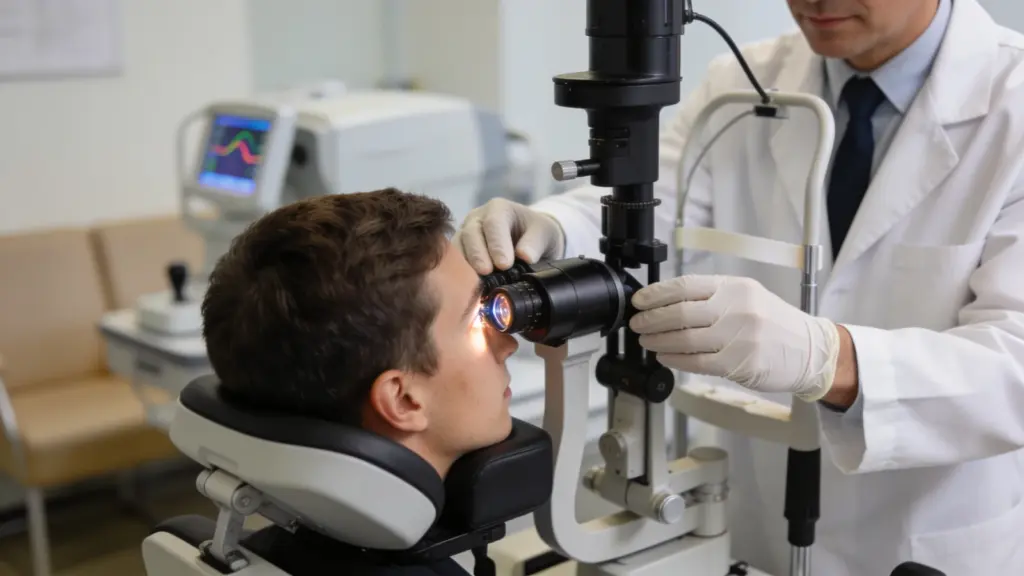
ortho k candidate evaluation — young patient with myopia during eye exam

Ortho-K works best for myopia up to about -6.00 D. Above that threshold, the amount of corneal reshaping required exceeds what overnight wear can reliably deliver, and residual blur is common. Mild astigmatism can often be corrected alongside myopia; significant astigmatism usually can’t. Very low prescriptions — below -0.75 D — don’t benefit enough to justify the cost.

People with keratoconus, severe dry eye, or other corneal irregularities are generally poor candidates because the reshaping process depends on a predictably shaped cornea and adequate tear film. Your optometrist will assess candidacy before quoting a price — if a practice quotes without a topography screening first, that’s a red flag.

People Also Ask

How much do ortho-K lenses cost?

The first-year cost of ortho-K lenses typically ranges from $1,500 to $4,000, with a national average around $2,000 to $2,800. This covers the corneal topography mapping, custom lens design, the lenses themselves, and all follow-up fitting visits in the first year. From year two onward, the annual cost drops to $300 to $800 for lens replacement and monitoring visits.

Does insurance cover ortho-K lenses?

Standard vision insurance does not cover ortho-K because it is classified as elective, not medically necessary. However, FSA and HSA funds can generally be used for ortho-K, which effectively reduces the cost by your tax rate. Check with your benefits provider before treatment begins, since some FSA plans have restrictions on how elective vision procedures are categorized.

Is ortho-K cheaper than LASIK?

Upfront, yes — ortho-K typically costs $1,500 to $4,000 for the first year compared to $2,000 to $4,500 for LASIK per eye. But ortho-K has ongoing annual costs of $300 to $800 indefinitely, since the corneal reshaping reverses when you stop wearing the lenses. LASIK is a one-time procedure with no recurring lens expense. Over ten years, LASIK is usually less expensive for adults whose prescription has stabilized. For children and teenagers, ortho-K makes more sense because LASIK is not approved until vision stabilizes.

Who is not a good candidate for ortho-K lenses?

Ortho-K is primarily designed for myopia up to about -6.00 D. Above that threshold, the corneal reshaping is generally insufficient to fully correct vision. People with severe dry eye, keratoconus, or other corneal irregularities are also poor candidates since the reshaping process depends on a normally shaped cornea. Very low prescriptions — below -0.75 D — typically don’t benefit enough to justify the cost.

Written by

Megan Richards

Contact Lens Content Researcher

Megan researches and writes about contact lens fitting, prescription conversion, and the optical standards that govern both. Her work focuses on explaining the math behind vertex distance in plain language, with every article grounded in clinical references such as ISO 8980-1, ANSI Z80.1, and AAO patient education resources.

Reviewed: