Glasses and contacts correct the same vision problem but they are not interchangeable, and the differences go well beyond comfort. The prescriptions themselves are different documents, the long-term cost works out differently, and at higher powers, one option is genuinely more accurate than the other. Here’s the full glasses vs contacts prescription comparison before you decide.
Is Your Glasses Prescription the Same as Your Contacts?
No. A glasses prescription gives you sphere (SPH) and cylinder (CYL) power — the correction your eyes need at a distance of about 12mm from your cornea, which is where spectacle lenses sit. A contact lens prescription needs that same power recalculated for zero distance, since contacts rest directly on the eye, plus two measurements glasses never require: base curve (BC) and diameter (DIA), which determine fit rather than power.
For prescriptions under ±4.00 D, the power difference between the two is usually small enough to ignore. Above that threshold, the gap becomes clinically relevant — a -6.00 D glasses prescription typically converts to roughly -5.50 D to -5.75 D in contacts. If you want to see the exact difference for your own numbers, our vertex distance calculator applies the same formula optometrists use.
Cost Comparison: Glasses vs Contacts Over 5 Years
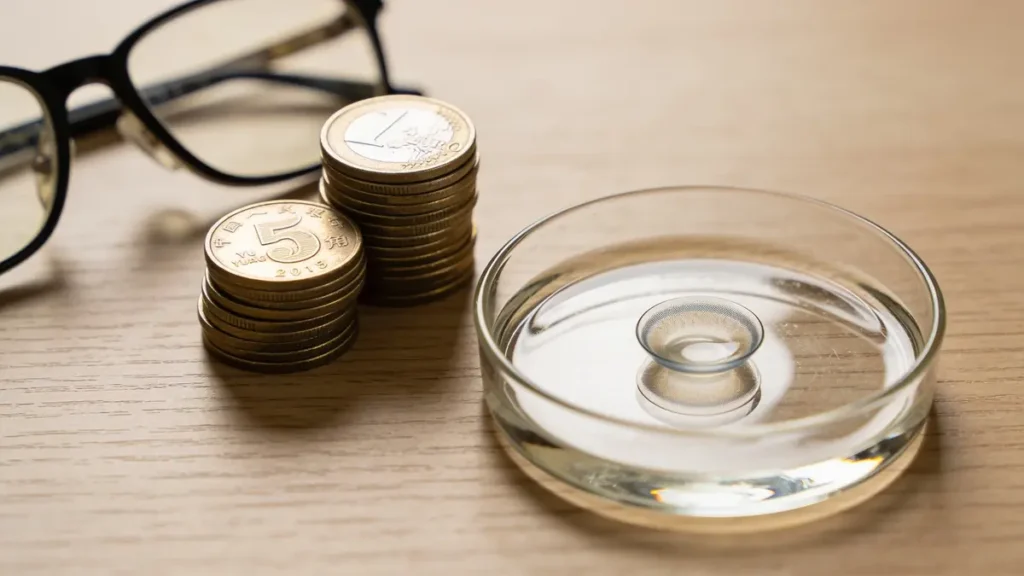
Glasses carry a higher upfront cost but very little recurring spending. A basic pair runs $200 to $600, with designer frames or premium lenses pushing that to $800 or more. Outside of repairs or a prescription change, there’s nothing else to budget for. Over five years, total glasses spending typically lands between $300 and $800.
Contacts work in the opposite direction. Daily disposables run $30 to $70 a month ($360-$840 a year), monthly lenses are cheaper at $15 to $30 a month, and both require ongoing solution costs of $50 to $100 a year. Toric or multifocal lenses add 20-50% on top of standard pricing. Over five years, total contact lens spending typically falls between $1,000 and $4,700 depending on lens type and replacement schedule.
| Factor | Glasses | Contacts |
|---|---|---|
| Upfront cost | $200-$800 | $0-$50 (fitting exam) |
| Recurring cost | Minimal | $15-$70/month |
| 5-year total | $300-$800 | $1,000-$4,700 |
| Replacement trigger | Prescription change or damage | Scheduled (daily/monthly) |
Accuracy: Which One Corrects Vision Better?
At low to moderate prescriptions, both options correct vision equally well. The difference shows up once you move into stronger powers. A spectacle lens sits roughly 12mm from your cornea, and at higher diopter values that distance introduces peripheral distortion — straight lines bending slightly near the edge of the lens, a smaller effective field of view, and a slight magnification or minification effect depending on whether your prescription is plus or minus.
Contact lenses don’t have this problem because they sit directly on the eye at zero vertex distance. They move with your eye instead of staying fixed in front of it, which means your full field of view stays sharp, including your peripheral vision. For prescriptions above ±6.00 D, this difference becomes noticeable enough that many people report contacts feel like a genuinely clearer, wider view rather than just a more convenient one.
This is also why the prescription conversion matters so much at higher powers. Using your glasses SPH value directly in contacts at ±6.00 D or above will measurably overcorrect or undercorrect your vision, even though the same numbers work fine at ±2.00 D.
Comfort and Daily Life
Glasses require almost no daily routine — clean the lenses, store them safely, done. They also carry zero infection risk since they never touch the eye. The tradeoff is that they can slide during exercise, fog up in temperature changes, and limit peripheral vision through the frame edges regardless of prescription strength.
Contacts remove the frame entirely, which is the main reason people switch for sports or active lifestyles. The tradeoff is a daily hygiene routine, a higher chance of dryness or irritation with long screen time, and a small but real infection risk if lenses aren’t cleaned or replaced on schedule. Most people who try both end up preferring contacts for activity and glasses for end-of-day rest, rather than picking one permanently.
Astigmatism: Does It Change the Decision?
If you have astigmatism, glasses correct it the same way regardless of severity — the lens grinds in the cylinder and axis values precisely, at any angle. Contacts need a specific lens type called toric, which is manufactured with fixed axis increments and weighted to resist rotating on the eye. Mild astigmatism (CYL under -0.75 D) is often absorbed into a standard spherical contact lens without needing a toric design. Stronger astigmatism requires toric lenses, which cost more and need a slightly more careful fitting to stay stable, but modern toric lenses are stable enough that astigmatism alone is rarely a reason to rule out contacts.
Can You Use Both? (Dual Wear)
Switching between glasses and contacts on different days, called dual wear, is more common than most people realize, and there’s no medical downside to doing it. You need a valid, current prescription for each since they’re separate documents, but plenty of contact lens wearers keep glasses as a backup for days their eyes feel irritated, for the evening after removing lenses, or simply for days they don’t want the maintenance.
If you’re considering this approach, getting your contact lens fitting done properly the first time matters more, since you’ll be relying on it less consistently than someone who wears contacts daily. The fitting itself doesn’t change, but treating both prescriptions as equally current avoids ending up with an expired or outdated contact lens prescription when you do want to wear them.
People Also Ask
Can I use my glasses prescription to buy contact lenses?
No. A glasses prescription only gives you sphere and cylinder power. Contact lenses sit directly on your eye instead of 12mm in front of it, which changes the effective power needed, especially above ±4.00 D. Contact lenses also require base curve and diameter measurements that only a contact lens fitting can provide. Ordering contacts with your glasses prescription will likely give you the wrong power and a poor fit.
Are contacts more accurate than glasses for high prescriptions?
For moderate to high prescriptions, contacts often provide a more accurate field of vision because they move with your eye and sit at zero vertex distance, eliminating the peripheral distortion that thick spectacle lenses introduce at higher powers. Glasses lenses above ±6.00 D can cause noticeable edge distortion and a smaller effective field of view, an effect contacts don’t have since they’re centered directly on the cornea.
Is it cheaper to wear glasses or contacts long term?
Glasses are typically cheaper over five years if your prescription stays stable, since the main cost is the one-time purchase. Contacts have lower upfront cost but recurring monthly spending on lenses and solution, which adds up over time. Five-year totals for glasses generally run $300 to $800, while contacts can total $1,000 to $4,700 depending on lens type and replacement schedule.
Can I switch between glasses and contacts on different days?
Yes, this is called dual wear and a large share of contact lens wearers already do it. You need a valid prescription for each, since they’re different documents, but there’s no medical reason you can’t alternate. Many people wear contacts during the day and switch to glasses in the evening to give their eyes a break, or keep glasses as a backup for when their eyes are irritated or they don’t have time to insert lenses.