A contact lens stuck in eye is one of the most alarming sensations a lens wearer can have — but in almost every case, it looks far worse than it is. If you’re wondering what to do if a contact lens is stuck in your eye right now, the short version is: stay still, don’t rub, and follow the steps below. Before anything else, know this: a contact lens cannot get lost inside your eye or travel behind it. What’s happening is almost always simpler than it feels, and it’s fixable in a few minutes with the right steps.
Can a Contact Lens Really Get Stuck Behind Your Eye?
No — and this is worth stating plainly because it’s the fear behind most of the panic. Your eye is covered by a thin, continuous membrane called the conjunctiva. It lines the inside of your eyelids and folds back to cover the white part of your eyeball, creating a sealed pocket with no opening leading further back. There is physically nowhere for a lens to go beyond that fold.
That fold is called the fornix, and it’s the furthest a displaced lens can travel — still on the front surface of your eye, just tucked out of view under the eyelid. A contact lens stuck behind eye is, in the literal sense, not something that can happen. What people are actually feeling is a lens that has shifted position, dried out, or folded on itself.
Where the Lens Actually Is

When a lens feels stuck, it’s almost always in one of three places. It may still be centered on your cornea but has dried out enough to grip the surface and resist normal blinking. It may have slid onto the white part of your eye (the sclera), which is harmless but can feel unusual since there’s less sensation there. Or it may have tucked itself under your upper eyelid, which is the scenario that triggers the most panic because you genuinely can’t see it.
If you can’t locate the lens at all, check whether it actually fell out first — onto your cheek, the sink, or the floor. It’s common to feel a phantom “something’s still in there” sensation even after a lens has already come out, especially if your eye is dry or slightly irritated.
How to Get It Out, Step by Step
1. Wash your hands. Soap, no oils or lotions, dry completely. Anything on your fingers transfers straight to your eye.
2. Rinse with saline or rewetting drops. Don’t use multipurpose contact solution as an eye wash — it’s meant for cleaning lenses outside the eye, not for direct application. A few drops of sterile saline or approved rewetting drops will rehydrate a dried-out lens and make it easier to move.
3. Blink several times. This alone often re-centers a displaced lens. Give it 10-15 seconds before moving to the next step.
4. If it’s under your eyelid, massage gently. Close your eye and use a clean finger to softly massage the eyelid in the direction you believe the lens has moved. Look in the opposite direction as you do this — if you suspect it’s under your upper lid, look down.
5. Locate it in a mirror, then slide it out. Once visible, use the pad of your finger to slide the lens onto the white of your eye, then gently pinch it between your index finger and thumb to remove it. Never pull at a lens that’s still firmly stuck — rehydrate it more first.
If It’s a Gas Permeable Lens
Hard or gas permeable lenses don’t dry out the way soft lenses do, so a stuck GP lens is usually a fit or positioning issue rather than dehydration. The same saline-and-massage approach applies, but GP lenses can sit more firmly against the cornea. If a gas permeable lens won’t move after a few minutes of gentle effort, don’t keep trying — these lenses are more likely to need professional removal, and forcing one carries a higher risk of scratching the eye.
When to Stop and Call a Doctor
Most stuck lenses resolve within a few minutes of calm effort. Stop and call your eye doctor or visit urgent care if any of the following apply: you’ve tried for 15-20 minutes without success, you feel sharp pain rather than general discomfort, your eye is significantly red or watering heavily, you’re sensitive to light, your vision doesn’t clear after the lens is removed, or you suspect the lens tore and a fragment may still be in your eye. None of these are reasons to panic, but they are reasons to get the right help instead of continuing to try at home.
Why Your Lens Keeps Getting Stuck
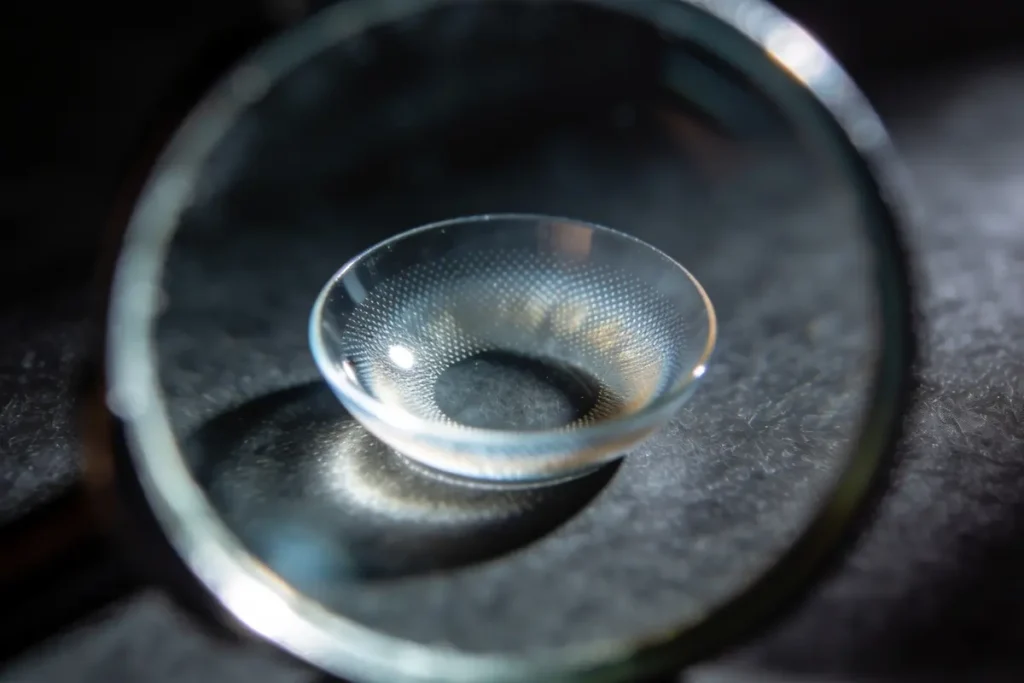
A lens that gets stuck once tends to get stuck again unless something changes. The most common cause is simple dryness — tears evaporate faster than you’d expect, especially with long screen time, air conditioning, or not blinking enough. Sleeping in lenses not approved for overnight wear is another major contributor, since the eye gets far less oxygen and moisture overnight. Wearing lenses past their replacement schedule, or a base curve that doesn’t quite match your cornea, can also make a lens more prone to shifting or sticking.
If this happens more than occasionally, it’s worth mentioning to your optometrist at your next visit — it may simply mean your fit needs rechecking. If you recently switched from glasses to contacts, a mismatched prescription conversion can also play a role; our vertex distance calculator helps confirm your numbers are correct.
Getting the insertion technique right from the start also reduces how often a lens shifts or dries out mid-wear — if you’re newer to contacts, our guide on how to put a contact lens in covers the basics.
People Also Ask
Can a contact lens get stuck in your eye?
Yes, but not in the way most people fear. A lens can shift out of its normal centered position, dry out and grip the surface of the eye, or slide under the upper eyelid where it’s harder to see. All of these are temporary and treatable with saline, blinking, and gentle massage. What it cannot do is travel behind the eyeball or get permanently lost inside the eye — the eye’s anatomy makes that impossible.
Can a contact lens get stuck behind your eye?
No. This is anatomically impossible. A membrane called the conjunctiva lines the inside of your eyelids and folds back to cover the white part of your eye, forming a continuous, sealed pocket. There is no opening behind your eyeball for a lens to travel through. The furthest a displaced lens can go is into that fold, called the fornix, which is still on the front surface of your eye — just hidden under the eyelid.
What should I do if I can’t find my contact lens but feel like it’s still there?
First, confirm it didn’t already fall out — check your cheek, the sink, or the floor. If you’re sure it’s still in your eye, the sensation without a visible lens usually means it’s tucked under your upper eyelid or has dried out enough to feel like a foreign object. Add a few drops of saline or rewetting drops, close your eye, and gently massage your upper eyelid. Look in different directions while doing this — the lens will often become visible once it’s moved back into your field of view.
Is it an emergency if I can’t remove a stuck contact lens?
Not usually, but there are exceptions. If you’ve calmly tried saline, blinking, and gentle massage for 15-20 minutes without success, or if you experience sharp pain, significant redness, light sensitivity, or vision changes, stop trying and call your eye doctor or visit urgent care. These signs can indicate the lens has torn, the cornea is irritated, or there’s an underlying infection that needs professional attention.
Can a contact lens scratch my eye if it’s stuck?
It’s possible, though uncommon, particularly if you try to force the lens out while it’s dry or folded, or if the lens itself has torn. A scratch on the cornea (corneal abrasion) typically causes sharp pain, tearing, and light sensitivity that doesn’t improve once the lens is out. If you notice these symptoms after removing a stuck lens, see an eye doctor rather than waiting it out — corneal abrasions heal faster with proper care and monitoring.