If your glasses prescription has a minus sign, your contact lens prescription will almost always show a different number — usually a smaller minus. That’s not an error, and it has nothing to do with your eyes changing. It’s a direct result of how myopia is corrected and where the correcting lens sits relative to your eye.
Here’s exactly how myopia affects your contact lens prescription at every level of nearsightedness, and why the numbers change the stronger the diopter value gets.
What the Minus Sign Actually Means
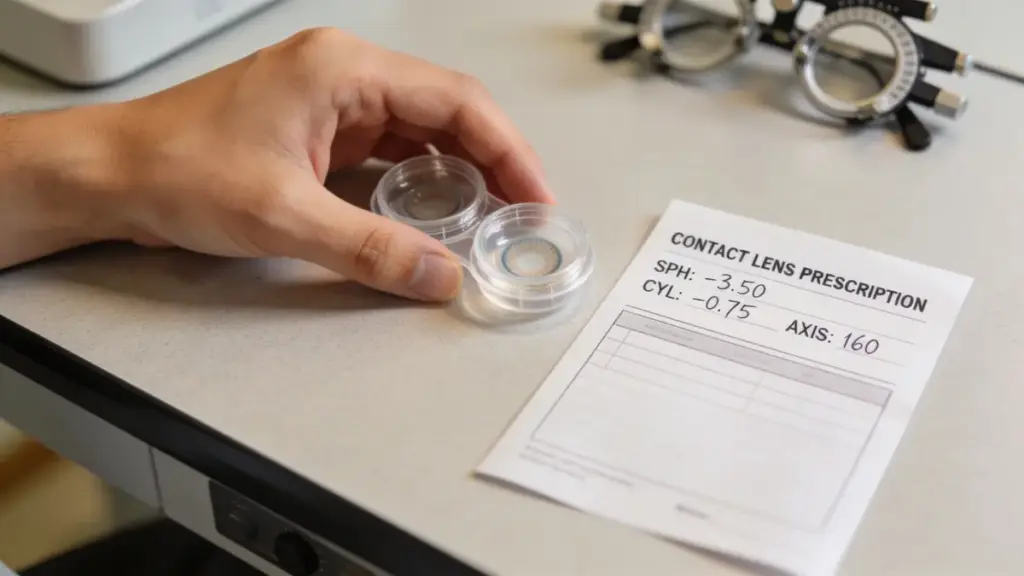
Myopia happens when the eye focuses light in front of the retina instead of on it. Distant objects blur because the focal point lands too early. A minus lens corrects this by diverging light before it enters the eye, pushing the focal point back onto the retina.
On your prescription, the SPH value carries the minus sign. A prescription of -1.00 D is mild — you probably struggle with distant road signs but manage reasonably well day-to-day. At -3.00 D, reading a whiteboard across a classroom without correction becomes genuinely difficult. At -6.00 D, clear uncorrected vision is limited to roughly arm’s length. Standard soft contact lenses are manufactured down to -12.00 D, and prescriptions beyond that exist — they just require a different lens category.
Why Your Contact Lens Power Is Lower Than Your Glasses
Glasses sit approximately 12mm in front of your cornea. Contact lenses sit directly on the tear film covering it. That distance — called vertex distance — changes the effective power your eye receives from the lens.
For minus prescriptions, closing that gap means less minus power is needed to achieve the same result. A glasses prescription of -6.00 D typically converts to around -5.50 D to -5.75 D in contacts. The difference grows as the prescription gets stronger, which is why it can’t be ignored at higher powers. At -2.00 D, the gap is negligible and often rounds to zero. At -8.00 D, using your glasses SPH directly in contacts would give you meaningfully over-minused lenses.
The threshold where this starts to matter clinically is around ±4.00 D. Below that, optometrists sometimes round to the same value. Above it, the conversion is calculated precisely and confirmed with a trial lens during your fitting. Our vertex distance calculator applies the same formula to show you the exact converted power for your specific prescription.
Why High Myopia Looks Different Through Contacts
At low myopia, glasses and contacts deliver similar visual quality. The difference becomes noticeable once you move into stronger minus powers — and it goes beyond the prescription number itself.
Thick minus lenses cause peripheral distortion. Objects near the edges of the frame appear compressed, slightly curved, or displaced — sometimes called the “fishbowl effect” — and it worsens as lens thickness increases. Contacts don’t have this problem because they move with your eye. Your entire field of view gets the same correction simultaneously, including the periphery. This is why people with high myopia often report that contacts feel like a genuinely clearer, wider view. For a broader look at how glasses and contacts compare on accuracy and comfort, our glasses vs contacts prescription comparison covers this in detail.
Myopia by Severity: What Each Range Means for Your Lenses
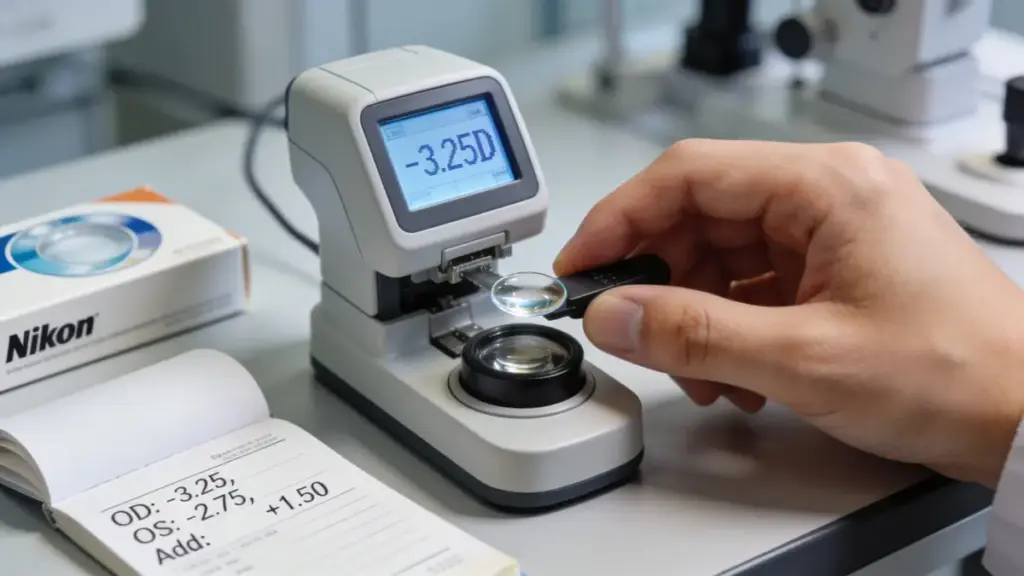
Mild myopia (-0.25 to -3.00 D) — Standard soft lenses correct this range easily. The vertex distance difference between your glasses and lens prescription is small, often negligible. Most major lens brands cover this range in daily and monthly formats.
Moderate myopia (-3.00 to -6.00 D) — The prescription conversion becomes relevant here. Your contact lens power will be a measurably smaller minus than your glasses. Daily disposables are widely available, though selection narrows slightly above -5.00 D depending on the brand.
High myopia (-6.00 to -12.00 D) — The vertex distance gap is significant at these powers. Peripheral distortion in glasses is pronounced; many people with high myopia switch to contacts primarily for the wider, undistorted field of view. Lens selection narrows considerably above -8.00 D, and not all brands manufacture daily disposables at the higher end of this range.
Very high myopia (above -12.00 D) — Standard soft lens manufacturing limits are reached. Custom soft lenses, rigid gas permeable lenses, or scleral lenses become the practical options. Each requires a separate fitting and its own specific prescription.
When Standard Soft Lenses Aren’t Enough
Standard soft lenses cover the majority of myopia cases. The situations where they fall short are predictable: prescriptions above -12.00 D, corneal irregularities that prevent a soft lens from sitting correctly, and cases where the optical precision of a rigid lens is needed for maximum acuity.
Rigid gas permeable lenses correct myopia by creating a liquid lens between the rigid surface and the cornea, masking irregularities that soft lenses can’t. Scleral lenses vault over the cornea entirely, resting on the sclera — larger and more involved to insert, but they provide exceptional optical quality at powers where soft lenses struggle.
If your prescription approaches or exceeds -12.00 D, our vertex distance calculator gives you the starting conversion before a specialist fitting confirms the final values. Also useful before that appointment: our guide on how to read a contact lens prescription, since specialty lens prescriptions carry parameters that standard soft lens documents don’t.
People Also Ask
Why is my contact lens prescription weaker than my glasses?
Because glasses sit roughly 12mm in front of your cornea while contacts sit directly on it. That gap changes how much power your eye actually receives from the lens. For minus prescriptions, closing that gap means less minus power is needed to achieve the same correction — so your contact lens number is always a smaller negative than your glasses number, once you’re above roughly -4.00 D.
Can I wear contact lenses with a very high myopia prescription like -10.00 or -12.00?
Yes, but standard soft lenses top out at around -12.00 D. Most major brands offer soft lenses in the -10.00 to -12.00 range, though selection becomes narrower as the power increases. Above -12.00 D, custom soft lenses or rigid gas permeable lenses are typically the better fit — both optically and in terms of availability.
At what prescription strength does myopia start affecting daily life without correction?
Most people notice meaningful distance blur once they reach -1.00 D or beyond. At -2.00 D, reading a blackboard or street sign clearly without correction becomes difficult. By -4.00 D, recognizing faces across a room is unreliable. Above -6.00 D, functional uncorrected vision is limited to close range — roughly arm’s length and nearer.
Does wearing contact lenses slow or worsen myopia progression?
Standard single-vision contact lenses neither slow nor accelerate myopia progression — they correct existing blur without influencing how the eye grows. Specialized myopia control lenses, such as soft multifocal designs and orthokeratology lenses worn overnight, have shown meaningful slowing of progression in clinical studies, particularly in children and teenagers. If myopia control is a goal, those designs require a separate fitting and prescription from your optometrist.