The honest answer is that neither is universally better — they solve different problems. Daily lenses are built for convenience and hygiene. Monthly lenses are built for cost and durability. The right choice comes down to how often you wear contacts, how much lens care you’re willing to do, and what your eyes can tolerate.
Here’s what actually matters when you’re deciding.
How Each Type Works
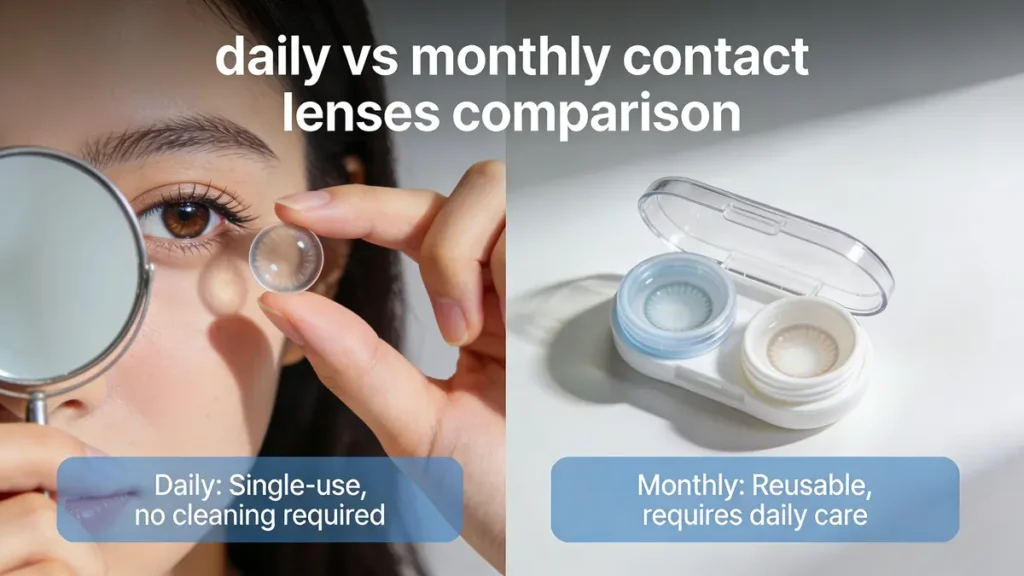
Daily disposables are single-use soft lenses. You open a fresh pair every morning and throw them away at the end of the day. No cleaning, no storage case, no solution. Each lens is worn exactly once.
Monthly lenses are designed to be worn daily for up to 30 days. Every night you remove them, clean them with a multipurpose or hydrogen peroxide solution, and store them in a case. After 30 days of use — not 30 calendar days — they’re replaced.
Both types are available in spherical designs for myopia and hyperopia, as well as toric designs for astigmatism and multifocal designs for presbyopia. Your converted contact lens prescription — whether daily or monthly — will use the same SPH and CYL values; the lens type doesn’t change how vertex distance conversion is calculated.
Eye Health and Infection Risk
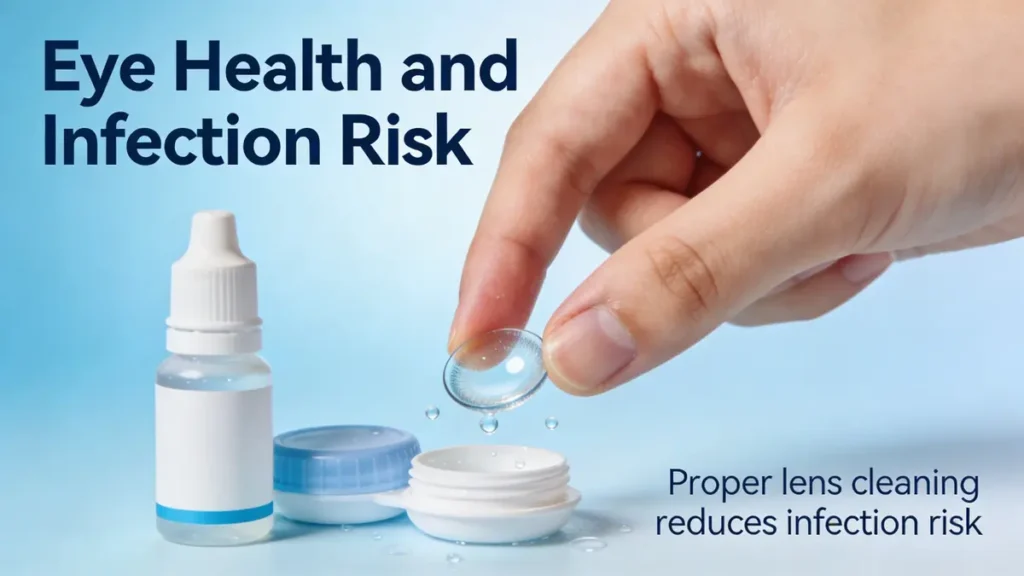
This is where daily lenses have a measurable clinical advantage. A 2024 study published in Acta Ophthalmologica found that daily disposable wearers had a serious eye infection rate of 0.52 per 10,000 wearers annually — nearly five times lower than the 2.52 per 10,000 rate seen with extended-wear monthly lenses.
The reason is straightforward: protein deposits, lipids, and bacteria accumulate on lens surfaces over time. A fresh lens every day eliminates that buildup entirely. Monthly lenses, even when cleaned properly, carry more residual deposit risk — especially for people with dry eyes or seasonal allergies.
If your eyes are sensitive, prone to dryness, or you’ve had past infections, daily lenses are the safer choice regardless of cost.
Cost: The Real Numbers
Monthly lenses are cheaper per lens. But “per lens” is the wrong unit to compare.
| Lens Type | Annual Cost (both eyes) | Additional Costs | Total Estimate |
|---|---|---|---|
| Daily disposable | $200 – $500 | None | $200 – $500 |
| Monthly | $100 – $200 | Cleaning solution ~$100–$150/yr | $200 – $350 |
When you factor in solution costs, the annual difference narrows significantly — often to less than $100. For occasional wearers (a few days per week), daily lenses become even more cost-effective since you only open a pair when you need it rather than going through a monthly supply on a shortened schedule.
Who Should Choose Daily Lenses
- Occasional wearers — if you wear contacts two or three days a week, daily lenses are almost always cheaper and more practical. Opening a fresh pair when needed is far more efficient than maintaining a monthly lens you’re only using part-time.
- Dry eye or allergy sufferers — fresh lenses daily means less deposit buildup, which is the primary cause of end-of-day dryness and irritation.
- Active lifestyles and travel — no solution bottles, no case, nothing to clean. One less thing to manage.
- New contact lens wearers — less risk while learning to handle lenses correctly.
Who Should Choose Monthly Lenses
- Full-time daily wearers — if you wear contacts every single day, monthly lenses offer better value and are environmentally less wasteful (365 pairs vs 24 per year).
- Higher prescriptions or toric wearers — monthly toric lenses for astigmatism correction are generally available in a wider range of CYL powers and axis values than daily toric options, giving your optometrist more fitting flexibility.
- Budget-conscious consistent wearers — for someone wearing contacts 6–7 days a week, the annual cost difference still favors monthly when solution is factored in.
What About Bi-Weekly (2-Week) Lenses?
Some lenses are designed for 14-day replacement schedules. They sit between daily and monthly in both cost and convenience — slightly more hygiene risk than daily but less accumulation than a full monthly schedule. They’re less common than they used to be as daily lenses have improved and come down in price. Unless your optometrist specifically recommends them, most wearers end up on daily or monthly.
The One Factor Most People Overlook
Compliance. Monthly lenses only perform as intended if you clean and replace them exactly as directed. Studies consistently show that a significant portion of monthly lens wearers stretch their replacement schedule — wearing lenses for 6 or 8 weeks instead of 4. This is when infection risk rises sharply and the cost savings stop making sense.
If you know yourself well enough to say you’ll replace on schedule, monthly lenses work. If you’re likely to push the schedule, the health argument for dailies is strong.
Quick Comparison
| Daily | Monthly | |
|---|---|---|
| Replacement | Every day | Every 30 days of use |
| Cleaning required | No | Yes, nightly |
| Infection risk | Lower | Higher with non-compliance |
| Best for occasional wear | Yes | No |
| Toric range (astigmatism) | Good, improving | Wider range available |
| Environmental impact | Higher waste | Lower waste |
| Annual cost (full-time wearer) | $200–$500 | $200–$350 (incl. solution) |
Before You Order: Get the Right Prescription
One detail that gets overlooked when switching between lens types: your contact lens prescription specifies both the optical power and the lens parameters (base curve and diameter) for a specific brand and design. A daily lens prescription from brand A isn’t automatically the right fit for a monthly lens from brand B, even if the SPH and CYL values are identical.
If your prescription was written for monthly lenses and you want to switch to dailies — or vice versa — have your optometrist confirm the fit. The vertex distance conversion that determines your sphere power remains the same, but the physical lens parameters may differ.
If you’re converting a glasses prescription to find your starting contact lens power, use the vertex distance calculator to get the corrected SPH and CYL values before discussing lens type with your optometrist.
Frequently Asked Questions
Can I sleep in daily contact lenses?
No. Daily disposable lenses are not approved for overnight wear. Sleeping in any lens that isn’t specifically designed for extended wear significantly increases infection risk, regardless of how new the lens is.
Are daily lenses better for dry eyes?
Generally yes. Fresh lenses daily means no accumulated deposits, which is a primary driver of lens-related dryness and end-of-day discomfort. Silicone hydrogel dailies offer the best oxygen transmission and moisture retention among disposable options.
Can I wear monthly lenses less than every day to make them last longer?
No. Monthly lenses degrade based on exposure to oxygen, proteins, and lens care products — not just wear time. Even if you only wore them 10 days, a 30-day-old opened lens should be replaced on schedule.
Do daily and monthly lenses have the same prescription values?
The optical power (SPH, CYL, Axis) is the same regardless of lens type. The difference is in base curve and diameter, which are lens-specific and determined during a fitting exam. Your vertex-corrected prescription values carry over directly when switching lens types.