Toric contact lens conversion works differently from a standard sphere-only conversion, because cylinder and axis don’t behave the same way sphere power does when moving from glasses to contacts. About half of all contact lens wearers have at least 0.75 D of astigmatism in one eye, yet toric lenses are only fitted in roughly a quarter of those cases — often because the conversion logic isn’t well understood. Here’s how it actually works.
Why Toric Lenses Need Their Own Conversion Logic
A standard sphere-only contact lens conversion changes one number using the vertex distance formula. Astigmatism conversion changes three interconnected values at once: sphere, cylinder, and axis. The sphere still shifts slightly due to vertex distance, the cylinder may shift by a smaller, related amount, and the axis describes an orientation that has to stay anchored to a physical lens that can move on the eye.
None of these three values can be adjusted in isolation without affecting how the lens performs. The sphere portion of that conversion follows the same vertex distance logic used for any prescription — our vertex distance calculator handles that part precisely, leaving cylinder and axis as the pieces unique to toric lenses.
This is also why a toric lens prescription can’t be filled with just sphere and cylinder numbers the way a glasses prescription can. A contact lens fitting confirms how the specific lens design holds its axis on your eye, which a written prescription alone can’t predict.
When Astigmatism Doesn’t Need a Toric Lens
Not every astigmatism prescription requires a toric lens. If your cylinder power is 0.75 D or lower, the distortion it causes is often mild enough that a standard spherical lens, calculated using your spherical equivalent, corrects your vision acceptably. Spherical equivalent combines your sphere and half your cylinder into a single number, effectively splitting the difference rather than correcting the astigmatism directly.
Above 0.75 D, that compromise becomes noticeable — print looks slightly doubled, lights show faint halos, or close-up work feels harder to focus. That’s the point where a toric lens, with its separate cylinder and axis correction, becomes worth the extra cost and slightly more involved fitting process. If you’re still weighing whether to stick with glasses or move to contacts altogether, our full prescription comparison covers cost, accuracy, and comfort side by side.
How Cylinder and Axis Convert From Glasses to Contacts
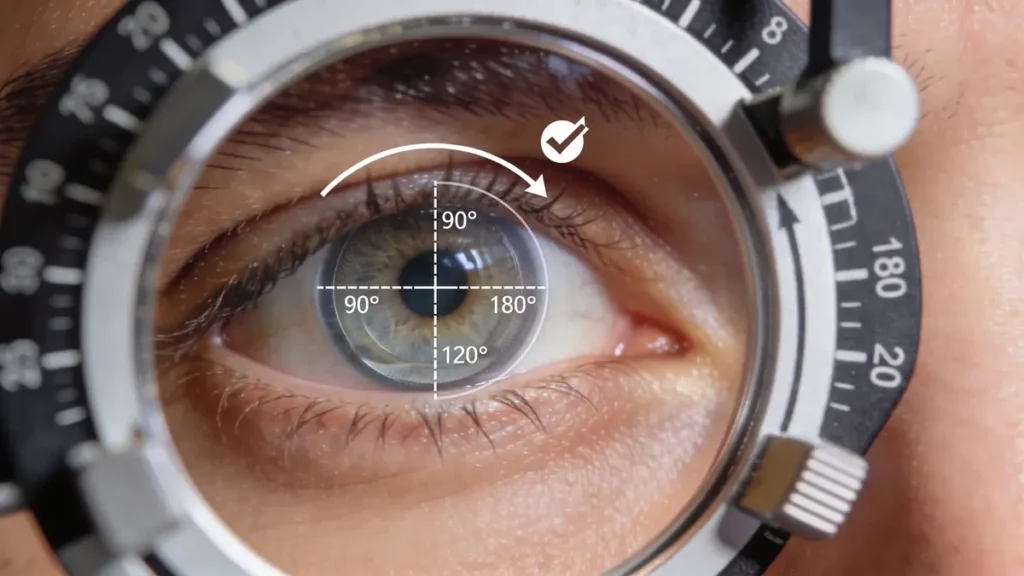
The axis value transfers as-is. It describes the angle of your astigmatism on the eye itself, between 0 and 180 degrees, and that orientation doesn’t change depending on what’s correcting it. Sphere and cylinder are different — both can shift slightly due to vertex distance, since contacts sit directly on the cornea instead of roughly 12mm in front of it. The sphere shift is usually the larger of the two; cylinder typically moves by a smaller amount in the same direction.
This is why a glasses prescription reading -3.00 SPH / -1.25 CYL / axis 90 doesn’t get copied directly onto a contact lens order. An optometrist recalculates the sphere and cylinder for the corneal plane, keeps the axis unchanged, then confirms the result fits and performs correctly with an over-refraction once the lens is actually on the eye.
Why Toric Lenses Rotate (and Why That’s Not a Conversion Error)
A toric lens has to land on one specific rotational position to align its cylinder correction with your astigmatism axis. Unlike a spherical lens, which works the same no matter how it’s oriented, a toric lens that’s rotated even 10 degrees off its intended position causes noticeably blurred or doubled vision, since the correction is now misaligned with the astigmatism it’s meant to cancel out.
A small wobble right after blinking is normal — the lens is settling, not malfunctioning. Lenses use your eyelid and gravity to nudge themselves back into the correct position within a few seconds. If a lens consistently rotates and stays off-axis, the cause is almost always one of three things: the fit doesn’t match your eyelid anatomy, the lens has dried out enough to lose its grip on the tear film, or the diameter and base curve don’t suit your eye shape. None of these point to an error in how your prescription was converted — they’re fitting issues, which is why an optometrist may adjust the ordered axis slightly to compensate for a lens that consistently settles a few degrees off from where it lands on paper.

Stabilization Design: Ballast, Thin Zone, and Truncation
Manufacturers use a few different methods to keep a toric lens from spinning. Prism ballasting adds extra thickness to the bottom of the lens, so gravity and your lower eyelid hold that heavier edge in place. Thin zone designs do the opposite — thinning specific areas so the eyelid’s natural blink pattern guides the lens into position. Truncation flattens the bottom edge of the lens slightly, giving the eyelid a straight edge to rest against rather than a curve.
None of these methods is universally better. The right one depends on your eyelid tension, blink pattern, and corneal shape, which is exactly what a contact lens fitting is checking for. If one brand’s stabilization design doesn’t suit your eyes, a different design from another brand often resolves rotation issues without changing your actual prescription numbers at all.
People Also Ask
Do I need toric contact lenses if I have astigmatism?
Not always. If your cylinder power is 0.75 D or less, a standard spherical contact lens can often correct your vision well enough without a toric design, using a calculation called spherical equivalent. Above 0.75 D, the uncorrected cylinder becomes noticeable enough that most people need a toric lens for clear, stable vision.
Why does my toric lens feel like it’s rotating?
Toric lenses are designed to settle into one specific rotational position, and they nudge back into place using your eyelid and gravity. A small amount of movement after blinking is normal and usually self-corrects within a few seconds. Lenses that rotate more than 10 degrees and stay misaligned typically point to a fit issue, dryness, or a stabilization design that doesn’t match your eyelid anatomy rather than a problem with your prescription itself.
Can my glasses cylinder and axis be used directly for contact lenses?
The axis value transfers directly since it describes the orientation of the astigmatism on your eye, which doesn’t change between glasses and contacts. The cylinder power may shift slightly due to vertex distance, the same effect that changes your sphere power, though this shift is usually smaller for cylinder than for sphere. Your optometrist confirms the final toric lens power during a fitting rather than using the glasses values directly.
Why are toric lenses more expensive than regular contacts?
Toric lenses require more complex manufacturing because each lens needs both a spherical and a cylindrical correction built in, plus a stabilization feature like ballasting or thin zones to keep the axis from rotating. This adds extra production steps and quality control compared to a standard spherical lens, which is reflected in the price, typically 20-50% more per box.