Most people never learn how to read a contact lens prescription — they just hand it to a retailer and hope for the best. But every abbreviation and number on that contact lens prescription has a specific meaning, and once you know what each field refers to, the whole thing takes about thirty seconds to parse. By the end of this, nothing on your prescription will be unfamiliar.
OD, OS, OU — Which Eye Is Which
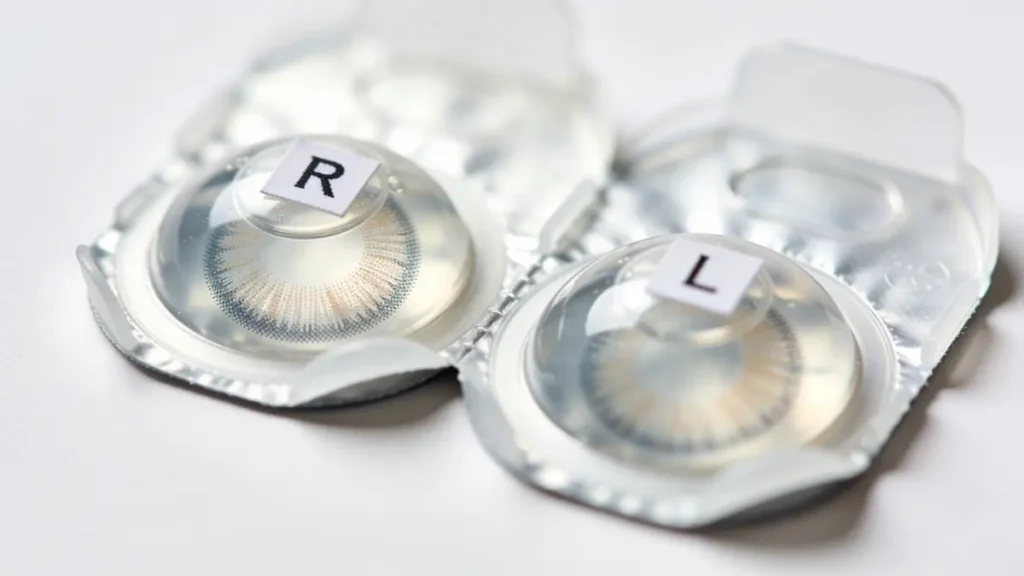
These three abbreviations come from Latin and appear on almost every eye care document you’ll ever receive. OD stands for oculus dexter — the right eye. OS stands for oculus sinister — the left eye. When both eyes share the same value, some prescriptions use OU (oculi uterque), meaning both eyes together.
On a contact lens prescription, OD is always listed first, OS second. If your eyes have different prescriptions — which is more common than not — each row will have its own set of values. Never assume the numbers for one eye apply to the other.
The Core Numbers: SPH, BC, and DIA
Every contact lens prescription contains at least these three values, regardless of whether you have astigmatism or not.
| Abbreviation | Full Name | What It Means | On Every Prescription? |
|---|---|---|---|
| OD | Oculus Dexter | Right eye | Yes |
| OS | Oculus Sinister | Left eye | Yes |
| SPH | Sphere | Vision correction power — minus for nearsighted, plus for farsighted | Yes |
| BC | Base Curve | Curvature of the lens back surface, fitted to your cornea (mm) | Yes |
| DIA | Diameter | Width of the lens from edge to edge (mm) | Yes |
| CYL | Cylinder | Astigmatism correction power — always negative in soft lenses | Only if you have astigmatism |
| AXIS | Axis | Orientation of astigmatism correction in degrees (0–180) — always paired with CYL | Only with CYL |
| ADD | Add Power | Extra near-vision power for multifocal lenses — always positive | Only if presbyopia |
SPH (Sphere) is the main vision correction power, measured in diopters. A minus sign means you’re nearsighted (myopia — distant objects are blurry). A plus sign means you’re farsighted (hyperopia — near objects are harder to focus). The number itself tells you the strength: a prescription of -1.00 is mild, while -6.00 is a strong everyday myopia prescription. Values outside that range exist but are less common in standard soft lenses.
BC (Base Curve) describes the curvature of the back surface of the lens — the side that sits against your eye. It is measured in millimeters, and most soft lenses fall between 8.4 and 9.0. A lower number means a steeper curve. BC matters because a lens that doesn’t match your corneal curvature will move around, feel uncomfortable, or not correct your vision reliably. It is not interchangeable between brands.
DIA (Diameter) is the width of the lens from edge to edge, also in millimeters. Standard soft lenses range from 13.5 to 14.5mm. The diameter determines how much of your cornea and surrounding tissue the lens covers — too small and it shifts with every blink, too large and it can restrict oxygen flow to the eye’s edge.
If You Have Astigmatism: CYL and AXIS

If your cornea isn’t perfectly round — it’s shaped more like a rugby ball than a football — you have astigmatism. Your prescription corrects for this with two additional values that always appear together.
CYL (Cylinder) is the power needed to correct the astigmatism. In soft contact lens prescriptions, CYL is always written as a negative number. Typical values range from -0.75 to -2.25, though higher corrections exist. A CYL of zero, or a blank field, means no astigmatism correction is needed.
AXIS tells the lens where to apply that cylindrical correction. It is a degree value between 0 and 180, indicating the orientation of the astigmatism on your eye. AXIS never appears without CYL — the two are inseparable. A CYL of -1.25 without an axis would be meaningless, because the lens wouldn’t know which direction to correct.
Lenses that include CYL and AXIS correction are called toric lenses. They are designed to stay in a fixed rotational position on your eye, which is why they can feel slightly different to insert than standard lenses. If you’re new to toric lenses, how to put a contact lens in covers what to expect when the lens needs a moment to settle into alignment.
ADD Power and Multifocal Lenses
ADD only appears on prescriptions for people with presbyopia — the gradual loss of near-focus ability that typically begins in the mid-40s. It represents the additional magnifying power built into the lower or reading zone of a multifocal lens.
ADD values are always positive and typically range from +0.75 to +3.00. Some prescriptions also note D (dominant) and N (non-dominant) alongside each eye’s values — this tells the lens manufacturer how to distribute the distance and near zones across both eyes for the most natural vision balance. If your prescription doesn’t include ADD, you don’t need multifocal lenses.
Why Your Contact Lens Numbers Differ From Your Glasses
If you hold your glasses prescription next to your contact lens prescription, the SPH values are often different — sometimes by 0.25, sometimes more. This isn’t an error. It’s the result of vertex distance.
Glasses sit approximately 12mm in front of your cornea. Contact lenses sit directly on it. That gap between the lens and the eye changes the effective optical power that reaches your retina. For mild prescriptions, the difference is small enough to ignore. But once you’re above ±4.00 SPH, the gap starts to matter — a glasses prescription of -5.00 might convert to -4.75 or -4.50 in a contact lens prescription, depending on your exact corneal distance.
The conversion isn’t a simple subtraction — it follows an optical formula based on your specific vertex distance. If you want to check how your glasses prescription converts to contact lens power, our vertex distance calculator does that calculation precisely.
A Real Prescription, Read Line by Line
Here’s a real-format prescription to walk through:
- OD: SPH -3.25 / CYL -0.75 / AXIS 180 / BC 8.6 / DIA 14.2
- OS: SPH -2.75 / BC 8.6 / DIA 14.2
Starting with the right eye (OD): the SPH of -3.25 means moderate nearsightedness — this person sees clearly up close but needs correction for distance. The CYL of -0.75 indicates mild astigmatism, and the AXIS of 180 means the astigmatism runs horizontally across the cornea. The lens prescribed is a toric lens with a base curve of 8.6mm and a diameter of 14.2mm.
The left eye (OS) has no CYL or AXIS. That means no astigmatism in that eye — a standard spherical lens with SPH -2.75 is sufficient. The BC and DIA are the same as the right eye, which is common when both eyes fit the same lens design. The right eye’s prescription is slightly stronger, which is entirely normal — most people’s eyes differ from each other.
People Also Ask
Can I use my glasses prescription for contact lenses?
No. A glasses prescription and a contact lens prescription are different documents. Glasses sit roughly 12mm in front of your cornea, while contacts sit directly on it — that distance changes the effective power needed, especially for prescriptions stronger than ±4.00 SPH. A contact lens prescription also includes fit measurements like BC and DIA that a glasses prescription never has. Using your glasses prescription to order contacts will almost certainly give you the wrong power and the wrong fit.
What does it mean if my contact lens prescription has no CYL or AXIS?
It means you don’t have astigmatism, or your astigmatism is mild enough that a standard spherical lens corrects it adequately. CYL and AXIS only appear when there is a measurable cylindrical correction needed. If those fields are blank or marked with plano (PL) or zero, a standard soft lens is all you need.
How long is a contact lens prescription valid?
In most countries, a contact lens prescription is valid for one to two years from the date of your fitting. The exact duration depends on local regulations and your eye care provider’s judgment — some practitioners issue one-year prescriptions by default, particularly if your prescription is strong or your eyes are prone to change. An expired prescription cannot legally be used to purchase lenses in most jurisdictions, which is why regular eye exams matter even if your vision feels unchanged.
Why does my contact lens prescription have a brand name on it?
Because contact lenses are medical devices fitted to a specific lens design, not just a set of numbers. BC and DIA values are not universal — a BC of 8.6 in one brand is manufactured to slightly different tolerances than a BC of 8.6 in another. Your optician fits you to a specific lens and writes that brand into the prescription to ensure you reorder the exact design your eyes were assessed in. Switching brands without a new fitting is not recommended, even if the numbers look identical.